Und dann auf "Zum Home-Bildschirm [+]".

Stöbern
genialokal zum Startbildschirm hinzufügen
Installieren Sie die genialokal App auf Ihrem Startbildschirm für einen schnellen Zugriff und eine komfortable Nutzung.
Installieren Sie die genialokal App auf Ihrem Startbildschirm für einen schnellen Zugriff und eine komfortable Nutzung.
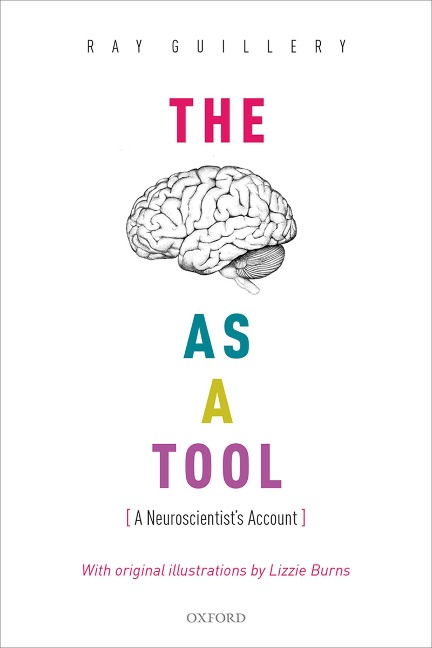
There are two distinct views about the functions of our brains and their origins. The standard view, taught in most neuroscience texts, has incoming messages about the world sent to the cerebral cortex, with the cortex then producing an appropriate motor output. The interactive view, largely expressed by philosophers and psychologists, stresses the continuous sensorimotor interactions of the brain with the world.
The Brain as a Tool focuses on thalamo-cortical interactions on the basis of the interactive view, exploring the phylogenetically new transthalamic corticocortical pathways of mammals that link a hierarchy of cortical areas to each other and back to the phylogenetically older motor centres for control of action. The book demonstrates how messages in these pathways produce an anticipation of our own actions and perceptions. In relating neural events to conscious processing and our sense of self , Guillery summarizes important evidence which links neuroscience with psychology and philosophy.
This book is essential reading for neuroscientists, cognitive psychologists and philosophers. Supplemented with a helpful glossary of neural terms and numerous illustrations of the brain, it is also an important resource for graduate and postdoctoral students interested in the neural bases of a sense of self and of cognitive functions.
Ray Guillery (1929-2017). Born in Germany, he became a neuroanatomist and obtained his BSc and PhD in Anatomy from University College London in 1951 and 1954. In his long and distinguished career, Ray taught at University College London (1953-64), University of Wisconsin-Madison (1964-77; 1996-2006), University of Chicago (1977-1984), University of Oxford (1984-96) and Marmara University (2006-2010). He was a Fellow of the Royal Society, a Fellow of University College London and was the founding Editor-in-Chief of the European Journal of Neuroscience. In his final position, Ray was an Honorary Emeritus Research Fellow at the MRC Brain Network Dynamics Unit at the University of Oxford.
- I HOW DO WE RELATE TO THE WORLD? - 1: The role of the brain - 2: The pathways for perception - 3: The pathways for action - 4: The subcortical motor centres - II MY ROUTE TO THE THALAMIC GATE - 5: Starting to study the brain - 6: The mamillothalamic pathways: My first encounter with the thalamus - 7: Comparative studies of the hypothalamus that led to studies of thalamic synapses - III ARRIVING AT THE THALAMIC GATE - 8: Defining the functional components of the thalamic gate - 9: Thalamic higher order driver inputs as sensorimotor links - 10: The hierarchy of cortical monitors - IV HIGHER CORTICAL FUNCTIONS - 11: Relating the neural connections to actions and perceptions - 12: Interacting with the world - 13: The role of the thalamocortical hierarchy - 14: The neural origins of a sense of self with a brief note on free will
Dieses eBook wird im PDF-Format geliefert und ist mit einem Adobe Kopierschutz (DRM) versehen. Sie können dieses eBook mit allen Geräten lesen, die das PDF-Format und den Adobe Kopierschutz (DRM) unterstützen.
Zum Beispiel mit den folgenden Geräten:
• tolino Reader
Laden Sie das eBook direkt über den Reader-Shop auf dem tolino herunter oder übertragen Sie das eBook auf Ihren tolino mit einer kostenlosen Software wie beispielsweise Adobe Digital Editions.
• Sony Reader & andere eBook Reader
Laden Sie das eBook direkt über den Reader-Shop herunter oder übertragen Sie das eBook mit der kostenlosen Software Sony READER FOR PC/Mac oder Adobe Digital Editions auf ein Standard-Lesegeräte mit epub- und Adobe DRM-Unterstützung.
• Tablets & Smartphones
Möchten Sie dieses eBook auf Ihrem Smartphone oder Tablet lesen, finden Sie hier unsere kostenlose Lese-App für iPhone/iPad und Android Smartphone/Tablets.
• PC & Mac
Lesen Sie das eBook direkt nach dem Herunterladen mit einer kostenlosen Lesesoftware, beispielsweise Adobe Digital Editions, Sony READER FOR PC/Mac oder direkt über Ihre eBook-Bibliothek in Ihrem Konto unter „Meine eBooks“ - „online lesen“.
Schalten Sie das eBook mit Ihrer persönlichen Adobe ID auf bis zu sechs Geräten gleichzeitig frei.
Bitte beachten Sie, dass die Kindle-Geräte das Format nicht unterstützen und dieses eBook somit nicht auf Kindle-Geräten lesbar ist.