Und dann auf "Zum Home-Bildschirm [+]".

Stöbern
genialokal zum Startbildschirm hinzufügen
Installieren Sie die genialokal App auf Ihrem Startbildschirm für einen schnellen Zugriff und eine komfortable Nutzung.
Installieren Sie die genialokal App auf Ihrem Startbildschirm für einen schnellen Zugriff und eine komfortable Nutzung.
Ihr gewünschter Artikel ist in 0 Buchhandlungen vorrätig - wählen Sie hier eine Buchhandlung in Ihrer Nähe aus:

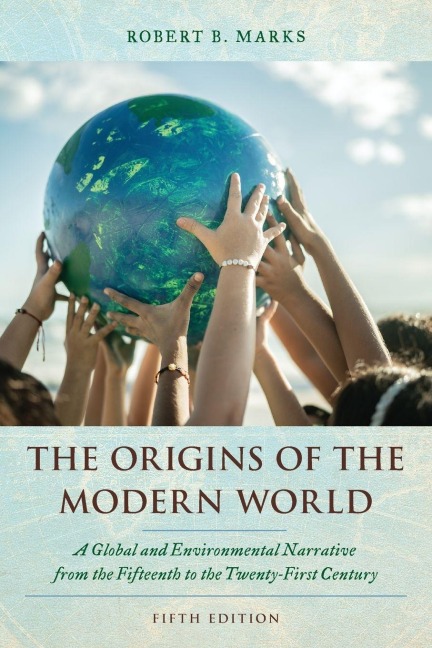
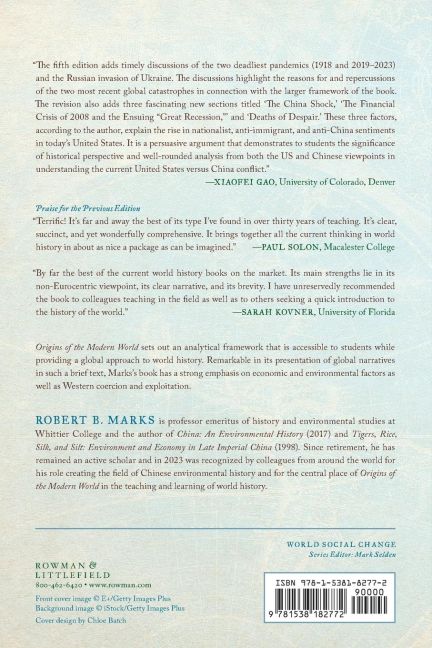
Origins of the Modern World sets out an analytical framework that is accessible to students while providing a global approach to world history. Remarkable in its presentation of global narratives in such a brief text. Marks's book has a strong emphasis on economic and environmental factors as well as Western coercion and exploitation.
Robert B. Marks was Richard and Billie Deihl Professor of History at Whittier College and the author of China: Its Environment and History (R&L 2012) and Tigers, Rice, Silk, and Silt: Environment and Economy in Late Imperial China (CUP 1998). He is the recipient of Whittier College's Harry W. Nerhood Teaching Excellence Award.
ContentsList of Figures and Maps Preface and Acknowledgments Introduction: The Rise of the West? The Rise of the West "The Gap" and Its Explanations Eurocentrism Stories and Historical Narratives The Elements of an Environmentally Grounded Non-Eurocentric Narrative Chapter One: The Material and Trading Worlds, circa 1400 The Biological Old Regime The Weight of Numbers Climate Change Population Density and Civilization The Agricultural Revolution Towns and Cities in 1400 Nomadic Pastoralists Wildlife Population Growth and Land Famine The Nitrogen Cycle and World History Epidemic Disease The World and Its Trading System circa 1400 The Black Death: A Mid-Fourteenth-Century Conjuncture Conclusion: The Biological Old Regime Chapter Two: Starting with China China The Voyages of Zheng He, 1405-33 India and the Indian Ocean Dar al-Islam, "The Abode of Islam" Africa57 Slavery Europe and the Gunpowder Epic Armed Trading on the Mediterranean Portuguese Explorations of the Atlantic Armed Trading in the Indian Ocean Conclusion Chapter Three: Empires, States, and the New World, 1500-1775 Empire Builders and Conquerors Russia and China Mughal, Safavid, and Ottoman Expansion The Dynamics of Empire The Americas The Conquest of the Americas and the Spanish Empire The Columbian Exchange The Great Dying Labor Supply Problems Silver The Spanish Empire and Its Collapse China's Demand for Silver The New World Economy Sugar, Slavery, and Ecology Human Migration and the Early Modern World The Global Crisis of the Seventeenth Century and the European State System State Building Mercantilism The Seven Years' War, 1756-63 Chapter Four: The Industrial Revolution and Its Consequences, 1750-1850 Cotton Textiles India The New World as a Peculiar Periphery New Sources of Energy and Power China Markets Exhausting the Earth England, Redux Coal, Iron, and Steam Recap: Without Colonies, Coal, or State Support Science and Technology Tea, Silver, Opium, Iron, and Steam Tea Silver Opium Iron and Steam Conclusion: Into the Anthropocene Chapter Five: The Gap Opium and Global Capitalism India Industrialization Elsewhere France The United States Germany Russia Japan New Dynamics in the Industrial World The Environmental Consequences of Industrialization The Social Consequences of Industrialization Nations and Nationalism The Scrambles for Africa and China Africa China El Niño Famines and the Making of the Third World Social Darwinism and Self-Congratulatory Eurocentrism Conclusion Chapter Six: The Great Departure Introduction to the Twentieth Century and Beyond Part I: Nitrogen, Wars, and the First Deglobalization, 1900-1945 World War I and the Beginning of the Thirty-Year Crisis, 1914-45 Revolutions Colonial Independence Movements Normalcy? The Great Depression of the 1930s World War II Part II: The Post-World War II and Cold War Worlds, 1945-91 Decolonization Asian Revolutions Development and Underdevelopment Consumerism versus Productionism Consumerism Third World Developmentalism Migration, Refugees, and States Global Inequality Inequality within Rich Countries Part III: Globalization and Its Opponents, 1991-Present The End of the Cold War The End of History? A Clash of Civilizations? Global Free Trade Energy, Oil, and War Deterritorialization Does History Repeat Itself? Part IV: The Great Departure: Into the Anthropocene Conclusion Conclusion: Changes, Continuities, and the Shape of the Future The Story Summarized Globalization Into the Future Notes Index About the Author