Und dann auf "Zum Home-Bildschirm [+]".

Stöbern
genialokal zum Startbildschirm hinzufügen
Installieren Sie die genialokal App auf Ihrem Startbildschirm für einen schnellen Zugriff und eine komfortable Nutzung.
Installieren Sie die genialokal App auf Ihrem Startbildschirm für einen schnellen Zugriff und eine komfortable Nutzung.


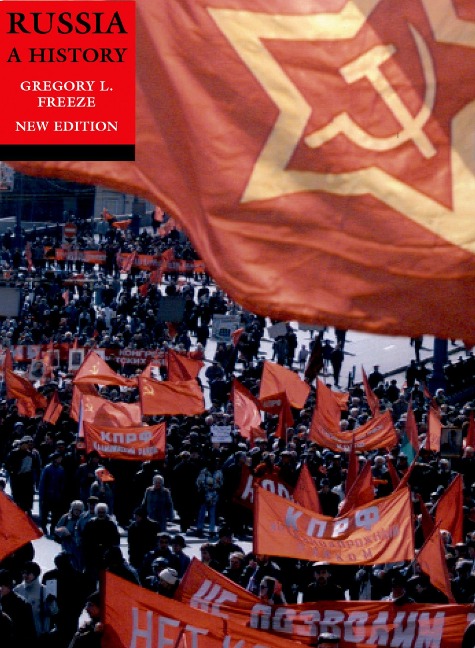
From the formation of the Russian state in the 14th century to the political power struggles of the 1990s and the uncertainties of the new millennium, this new history offers a fresh and systematic account of Russian history across six tumultuous centuries. With greater access to previously unobtainable material, and with the gradual depoliticization of what was once an intellectual Cold War battleground, historians are now able to tell the story of Russia more dispassionately and with greater precision than was formerly possible. Drawing on the best contemporary scholarship, and informed throughout by the latest archival research into previously classified sources, thirteen international experts here reassess and reinterpret the history of one of the world's great powers.
What emerges is a powerful sense of national destiny - of repeated themes, unchanging conditions, and cycles of circumstance. Throughout Russian history, all-powerful autocrats like Ivan the Terrible or Stalin have maintained their authority through brutality; but their omnipotence was always under threat, circumscribed by geography, compromised by bureaucratic incompetence, pervasive corruption, and resistance from below. A curious combination - a veneer of omnipotence, a void of operational power - has periodically dissolved into 'times of trouble', as in 1598, 1917, and 1991, when the impotence of the regime became transparent to all.
Russian rulers have also had to contend with the same immense physical challenges - a hugely dispersed population, a perennial dearth of means and men to govern, a primitive infrastructure. Plagued by natural disasters, hamstrung by structural problems, the Russian economy - whether pre-revolutionary capitalist, Soviet socialist, or post-Soviet semi-capitalist - has had enormous and disruptive difficulties adapting to the competitive world of international markets. Another immutable, elemental fact has been Russia's multinational composition, which continues to generate discontent and disorder. Yet Russia is a great survivor, as the years from 1995 show, charaterized by economic recovery, institution-building, and a new mood of self-assertion in world politics.
For too long Russian history has been dominated by myths and counter-myths, concocted by those seeking either to legitimize the existing order or to destroy it. This book - containing many little-known illustrations - represents an important attempt to rethink Russian history and to provide a new understanding of Russia's complex but ever-fascinating historical development. A compelling story in its own right, it is also essential reading for anyone with a private or professional interest in Russia and its place in the world.
Gregory Freeze is Professor of History at Brandeis University. He has also been a research associate of the Davis Center for Russian Studies at Harvard University since 1972 and is chief editor and director of the Russian Archive series, which publishes new inventories of recently declassified archival collections. He has spent over 12 years conducting research in the central and provincial archives of the former Soviet Union.
- List of Colour Plates - List of Maps - Editor's Preface - List of Contributors - Glossary of Terms, Abbreviations and Acronyms - Note on Transliteration and Dates - 1: Janet Martin: From Kiev to Muscovy: The Beginnings to 1450 - 2: Nancy Shields Kollmann: Muscovite Russia, 1450-1598 - 3: Hans-Joaachim Torke: From Muscovy towards St Petersburg, 1598-1689 - 4: John T. Alexander: The Petrine Era and After, 1682-1740 - 5: Gary Marker: The Age of Enlightenment, 1740-1801 - 6: David L. Ransel: Pre-Reform Russia, 1801-1855 - 7: Gregory L. Freeze: Reform and Counter-Reform, 1855-1890 - 8: Reginald E. Zelnik: Revolutionary Russia, 1890-1914 - 9: Daniel T. Orlovsky: Russia in War and Revolution, 1914-21 - 10: William B. Husband: The New Economic Policy (NEP) and the Revolutionary Experiment, 1921-1929 - 11: Lewis Siegelbaum: Building Stalinism, 1929-1941 - 12: William C. Fuller, Jr.: The Great Fatherland, War, and Late Stalinism, 1941-1953 - 13: Gregory L. Freeze: From Stalinism to Stagnation, 1953-1985 - 14: Martin McCauley: From Perestroika towards a New Order, 1985-95 - 15: Gregory L. Freeze: Meltdown, Rebuilding, Reform, 1996-2001 - Maps - Chronology - Further Reading - Index
Dieses eBook wird im PDF-Format geliefert und ist mit einem Adobe Kopierschutz (DRM) versehen. Sie können dieses eBook mit allen Geräten lesen, die das PDF-Format und den Adobe Kopierschutz (DRM) unterstützen.
Zum Beispiel mit den folgenden Geräten:
• tolino Reader
Laden Sie das eBook direkt über den Reader-Shop auf dem tolino herunter oder übertragen Sie das eBook auf Ihren tolino mit einer kostenlosen Software wie beispielsweise Adobe Digital Editions.
• Sony Reader & andere eBook Reader
Laden Sie das eBook direkt über den Reader-Shop herunter oder übertragen Sie das eBook mit der kostenlosen Software Sony READER FOR PC/Mac oder Adobe Digital Editions auf ein Standard-Lesegeräte mit epub- und Adobe DRM-Unterstützung.
• Tablets & Smartphones
Möchten Sie dieses eBook auf Ihrem Smartphone oder Tablet lesen, finden Sie hier unsere kostenlose Lese-App für iPhone/iPad und Android Smartphone/Tablets.
• PC & Mac
Lesen Sie das eBook direkt nach dem Herunterladen mit einer kostenlosen Lesesoftware, beispielsweise Adobe Digital Editions, Sony READER FOR PC/Mac oder direkt über Ihre eBook-Bibliothek in Ihrem Konto unter „Meine eBooks“ - „online lesen“.
Schalten Sie das eBook mit Ihrer persönlichen Adobe ID auf bis zu sechs Geräten gleichzeitig frei.
Bitte beachten Sie, dass die Kindle-Geräte das Format nicht unterstützen und dieses eBook somit nicht auf Kindle-Geräten lesbar ist.