Und dann auf "Zum Home-Bildschirm [+]".

Stöbern
genialokal zum Startbildschirm hinzufügen
Installieren Sie die genialokal App auf Ihrem Startbildschirm für einen schnellen Zugriff und eine komfortable Nutzung.
Installieren Sie die genialokal App auf Ihrem Startbildschirm für einen schnellen Zugriff und eine komfortable Nutzung.
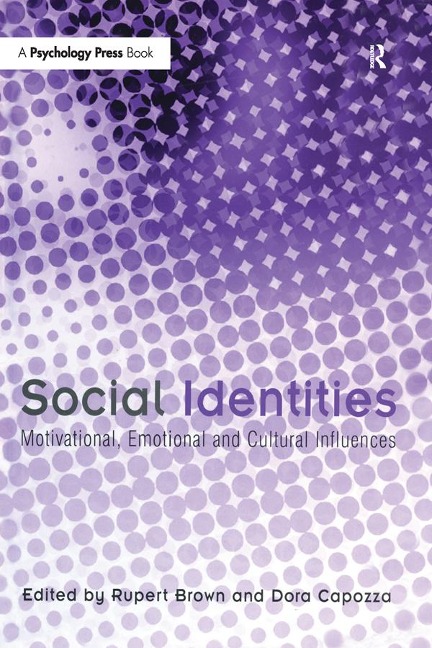
The concept of social identity occupies a central position in contemporary social psychology. Social Identities: Motivational, Emotional, Cultural Influences reports recent developments in the analysis of motivational and affective aspects of social identity processes. The book also examines the cross-cultural generality of Social Identity Theory explanations of intergroup competitiveness, which have strongly influenced international research in this area. People's social identities and self-evaluation are thought to be largely derived from group memberships; it is presumed that people are motivated to attain positivity in these identities by favouring the ingroup in intergroup comparisons. An increasing stream of research is being devoted to extending the applicability of social identity concepts to intergroup relations and related fields. The editors present here a collection of contributions from leading figures in social psychology which explore the state of the art in social identity theory. The most prominent motivational theories of identification are reported. Central themes concern: - motivations which lead individuals to join a group and identify with it - the role emotions have in favouring (or hindering) intergroup relations - the effect of emotions on intergroup behaviour - how people react to social identity threats Shedding new light on important social problems like prejudice, bigotry, and intense conflicts around the world, this unique volume will be indispensable to students and researchers of social psychology, sociology and cultural studies.
Rupert Brown received his PhD from the University of Bristol in 1979. Since then he has taught at the Universities of Kent and Sussex, where he has held Chairs in social psychology. His research interests include intergroup relations, prejudice and its reduction, and acculturation. Dora Capozza has taught social psychology in different Italian universities and different faculties. Since 1981 she has been Full Professor of Social Psychology at the University of Padova. Her primary area of research is the study of social identity and intergroup relations.
Introduction; Chapter 1 Motivational, emotional, and cultural influences in social identity processes, Rupert Brown, Dora Capozza; Part I Motivation, identification, and intergroup relations; Chapter 2 Self-conceptual uncertainty and the lure of belonging, Michael A. Hogg; Chapter 3 A comparison of motivational theories of identification, Dora Capozza, Rupert Brown, Sabina Aharpour, Rossella Falvo; Chapter 4 Extending the self in space and time: Social identification and existential concerns, Emanuele Castano, Vincent Y. Yzerbyt, Maria Paola Paladino, Andrea Carnaghi; Chapter 5 Living on the edge: Dynamics of intragroup and intergroup rejection experiences, Jolanda Jetten, Nyla R. Branscombe, Russell Spears; Chapter 6 Protecting a threatened identity through sexual harassment: A social identity interpretation, Anne Maass, Mara R. Cadinu; Part II Cultural and evolutionary aspects of ingroup identification; Chapter 7 Social identity motives in evolutionary perspective, Marilynn B. Brewer, Linnda R. Caporael; Chapter 8 Social identity theory in cross-cultural perspective, Peter B. Smith, Karen M. Long; Part III Emotions in intergroup relations; Chapter 9 It's about time: Intergroup emotions as time-dependent phenomena, Eliot R. Smith, Diane M. Mackie; Chapter 10 Connecting social identity theory and cognitive appraisal theory of emotions, Patricia Garcia-Prieto, Klaus R. Scherer; Chapter 11 Intergroup contact and the promotion of intergroup harmony: The influence of intergroup emotions, Stefania Paolini, Miles Hewstone, Alberto Voci, Jake Harwood, Ed Cairns; Chapter 12 Emotional antecedents and consequences of common ingroup identity, Kelly M. Johnson, Samuel L. Gaertner, John F. Dovidio, Missy A. Houlette, Blake M. Riek, Eric W. Mania; Chapter 13 Intergroup contact and levels of categorization: Effects on intergroup emotions, Roberto González, Rupert Brown;
Dieses eBook wird im PDF-Format geliefert und ist mit einem Adobe Kopierschutz (DRM) versehen. Sie können dieses eBook mit allen Geräten lesen, die das PDF-Format und den Adobe Kopierschutz (DRM) unterstützen.
Zum Beispiel mit den folgenden Geräten:
• tolino Reader
Laden Sie das eBook direkt über den Reader-Shop auf dem tolino herunter oder übertragen Sie das eBook auf Ihren tolino mit einer kostenlosen Software wie beispielsweise Adobe Digital Editions.
• Sony Reader & andere eBook Reader
Laden Sie das eBook direkt über den Reader-Shop herunter oder übertragen Sie das eBook mit der kostenlosen Software Sony READER FOR PC/Mac oder Adobe Digital Editions auf ein Standard-Lesegeräte mit epub- und Adobe DRM-Unterstützung.
• Tablets & Smartphones
Möchten Sie dieses eBook auf Ihrem Smartphone oder Tablet lesen, finden Sie hier unsere kostenlose Lese-App für iPhone/iPad und Android Smartphone/Tablets.
• PC & Mac
Lesen Sie das eBook direkt nach dem Herunterladen mit einer kostenlosen Lesesoftware, beispielsweise Adobe Digital Editions, Sony READER FOR PC/Mac oder direkt über Ihre eBook-Bibliothek in Ihrem Konto unter „Meine eBooks“ - „online lesen“.
Schalten Sie das eBook mit Ihrer persönlichen Adobe ID auf bis zu sechs Geräten gleichzeitig frei.
Bitte beachten Sie, dass die Kindle-Geräte das Format nicht unterstützen und dieses eBook somit nicht auf Kindle-Geräten lesbar ist.