Und dann auf "Zum Home-Bildschirm [+]".

Stöbern
genialokal zum Startbildschirm hinzufügen
Installieren Sie die genialokal App auf Ihrem Startbildschirm für einen schnellen Zugriff und eine komfortable Nutzung.
Installieren Sie die genialokal App auf Ihrem Startbildschirm für einen schnellen Zugriff und eine komfortable Nutzung.


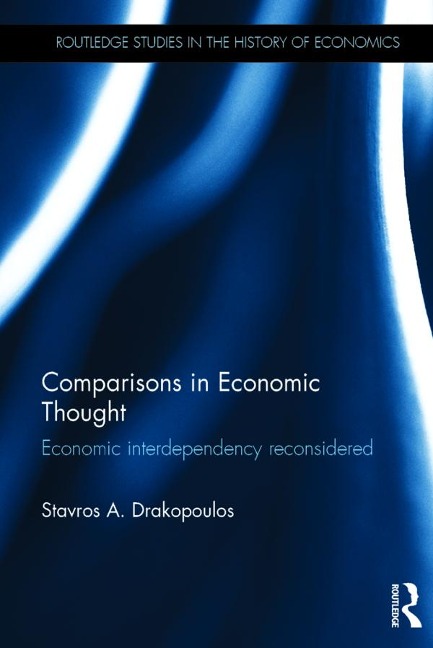
The idea of comparing rewards with others has a long and persistent presence in the social sciences, and can be found in many psychological, social and managerial theories. In economics, this idea can be traced back through the works of a substantial number of eminent thinkers, from Genovesi and Hume, to Smith, Ricardo, Marx, and Mill, through to Veblen, Pigou, and Keynes. In the last two decades the notion of social comparisons has started to appear more frequently in economic literature, especially in the subfield of happiness research. There are also signs that the notion has resurfaced in some strands of literature such as positional concerns, social identity models and social capital theory. Comparisons in Economic Thought offers a uniquely comprehensive account of how social comparisons have featured in the history of economic thought. This book provides an assessment as to why social comparisons have been dismissed by mainstream economists and considers their current and future usefulness. This volume is suitable for those who are interested and study history of economic thought, economic methodology and History of Consumer Theory, as well as Rational Choice Theory.
Stavros A. Drakopoulos is a full Professor of Economics in the Department of Philosophy and History of Science at the National and Kapodistrian University of Athens, Greece. His research interests include Economic Methodology and the History of Economic Thought, Labour Economics, and the Economics of Subjective Well-being.
Introduction 1. Social Comparisons in Other Social Sciences 2. Social Comparisons in Pre-classical and Classical Economic Thought 3. The Marginalization of Social Comparisons 4. The Reappearance of Social Comparisons 5. Social Comparisons in Microeconomics 6. Social Comparisons: Welfare, Macroeconomics and Labour Economics 7. Social Comparisons and Subjective Well-Being 8. Methodological Issues Epilogue
Dieses eBook wird im PDF-Format geliefert und ist mit einem Adobe Kopierschutz (DRM) versehen. Sie können dieses eBook mit allen Geräten lesen, die das PDF-Format und den Adobe Kopierschutz (DRM) unterstützen.
Zum Beispiel mit den folgenden Geräten:
• tolino Reader
Laden Sie das eBook direkt über den Reader-Shop auf dem tolino herunter oder übertragen Sie das eBook auf Ihren tolino mit einer kostenlosen Software wie beispielsweise Adobe Digital Editions.
• Sony Reader & andere eBook Reader
Laden Sie das eBook direkt über den Reader-Shop herunter oder übertragen Sie das eBook mit der kostenlosen Software Sony READER FOR PC/Mac oder Adobe Digital Editions auf ein Standard-Lesegeräte mit epub- und Adobe DRM-Unterstützung.
• Tablets & Smartphones
Möchten Sie dieses eBook auf Ihrem Smartphone oder Tablet lesen, finden Sie hier unsere kostenlose Lese-App für iPhone/iPad und Android Smartphone/Tablets.
• PC & Mac
Lesen Sie das eBook direkt nach dem Herunterladen mit einer kostenlosen Lesesoftware, beispielsweise Adobe Digital Editions, Sony READER FOR PC/Mac oder direkt über Ihre eBook-Bibliothek in Ihrem Konto unter „Meine eBooks“ - „online lesen“.
Schalten Sie das eBook mit Ihrer persönlichen Adobe ID auf bis zu sechs Geräten gleichzeitig frei.
Bitte beachten Sie, dass die Kindle-Geräte das Format nicht unterstützen und dieses eBook somit nicht auf Kindle-Geräten lesbar ist.