Und dann auf "Zum Home-Bildschirm [+]".

Stöbern
genialokal zum Startbildschirm hinzufügen
Installieren Sie die genialokal App auf Ihrem Startbildschirm für einen schnellen Zugriff und eine komfortable Nutzung.
Installieren Sie die genialokal App auf Ihrem Startbildschirm für einen schnellen Zugriff und eine komfortable Nutzung.
Ihr gewünschter Artikel ist in 0 Buchhandlungen vorrätig - wählen Sie hier eine Buchhandlung in Ihrer Nähe aus:

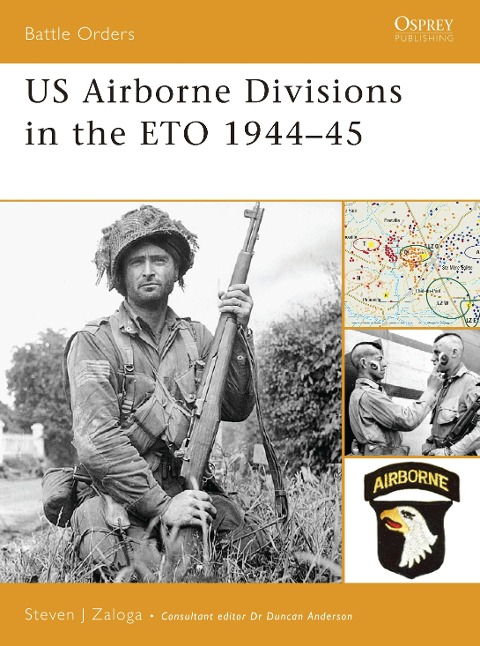
The delivery of entire divisions to battlefields behind enemy lines by parachute and glider was a unique feature of World War II. Failures at D-Day landings necessitated that, in order to avoid severe dispersion of paratroopers, US tactics be rethought and daylight airdrops be implemented. The new tactics were first put to the test in September 1944, with the landings by the 82d and 101st Airborne divisions as part of Operation Market Garden. Although the US landings were successful, the operation as a whole failed to secure its objectives. Nevertheless, both divisions subsequently played a vital defensive role withstanding the German Ardennes offensive. By 1945, another division had joined the airborne forces, and plans commenced for further airborne operations. The most significant of these was Operation Varsity, the airborne element of the Rhine River crossing in March 1945, which propelled the Allied armies into the heart of Nazi Germany, and effectively secured the outcome of the war. Paying special attention to often overlooked aspects of airborne operations, Battle Orders 25 gives a detailed account of the successes and failures of the US Airborne divisions within Europe, focusing on their organizational structure during 1944-45, and covering two of the world's finest units: the 82d and 101st 'Screaming Eagles.'
Steven J. Zaloga was born in 1952, received his BA in history from Union College, and his MA from Columbia University. He has published numerous books and articles dealing with modern military technology, especially armored vehicle development. His main area of interest is military affairs in the former Soviet Union and Eastern Europe in World War II, and he has also written extensively on American armored forces. The author lives in Maryland, USA.
Introduction Combat mission Doctrine and training Unit organization Tactics Command, control, communications and intelligence (C3I) Weapons and equipment Lessons learned Chronology Bibliography Glossary Index