Und dann auf "Zum Home-Bildschirm [+]".

Stöbern
genialokal zum Startbildschirm hinzufügen
Installieren Sie die genialokal App auf Ihrem Startbildschirm für einen schnellen Zugriff und eine komfortable Nutzung.
Installieren Sie die genialokal App auf Ihrem Startbildschirm für einen schnellen Zugriff und eine komfortable Nutzung.

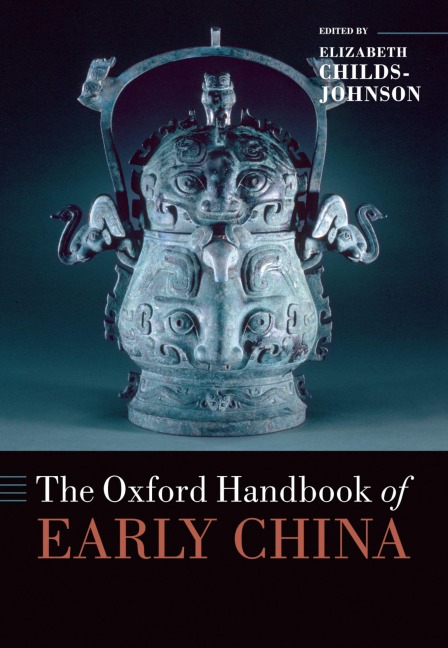
The Oxford Handbook on Early China brings 30 scholars together to cover early China from the Neolithic through Warring States periods (ca 5000-500BCE). The study is chronological and incorporates a multidisciplinary approach, covering topics from archaeology, anthropology, art history, architecture, music, and metallurgy, to literature, religion, paleography, cosmology, religion, prehistory, and history.
Elizabeth Childs-Johnson works on early Chinese art, archaeology, and paleography. Her major research interests include mapping a Jade Age and Shang Bronze Age in early China.
Section I: Introduction and Background by Elizabeth Childs-Johnson
Section II: Neolithic Farmers, Ceramics and Jade 1. The Neolithic revolution in the north, ca. 7/6000-2000 BCE Xinglongwa, Xinlei, Yangshao, Hongshan, and related cultures(Inequality/social complexity in Neolithic northern China), Andrew Womack, Yale University 2. The Neolithic revolution in the south, ca. 7/6000-2000BCE Majiabang, Hemudu, Daxi, Songze cultures, Xiangming Fang, Zhejiang IA 3. The Neolithic jade revolution in Northeast China, Chung Tang, Mana H. Tang, and Yadi Wen, Chinese Univ. of Hong Kong and Liu Guoxiang, CASS, IA 4. The Jade Age revisited, ca. 3500-2000BCE, Elizabeth Childs-Johnson, Independent Scholar 5. The Liangzhu Culture and the Ancient City of Liangzhu, Bin Liu, Zhejiang IA 6. Longshan Culture Issues: Taosi and cosmology by He Nu, CASS, IA
Section III: First Dynasty of the Bronze Age: Xia Period 7. Introduction: definitions, themes and debate by Xu Hong, Professor / Chair, Department of Xia-Shang-Zhou Archaeology, CASS, IA 8. Settlements, Buildings, and Society of the Erlitou Culture by Xu Hong and Li Xiang Hong Xu and Xiang Li 9. The bronze casting revolution and the ritual vessel set Hong Xu and Yu Liu 10.The spread of Erlitou yazhang (VM3:4) to South China: origin and dispersal of early political states and order in early China, Chung Tang, Chinese University of Hong Kong and Fang Wang, Jinsha Museum, Chengdu
Section IV: The First Height of the Bronze Age- The Shang Period 11. Shang cultural and historical setting, Jonathan Smith, Christopher Newport University and Yuzhou Fan, Nanjing University 12. Early and Middle Shang by Guoding Song, Department of History, Beijing Normal University 13. Shang religion, belief, and art by Elizabeth Childs-Johnson 14. Bronze casting technology and metallurgy issues, Changping Zhang, Wuhan University 15. Late Shang: Anyang Shang City architecture and layout, E. Childs-Johnson 16. Late Shang: Fu Zi and M5 at Xiaotun, Dingyun Cao, CASS, Institute of History
Section V: The Second Height of the Bronze Age: The Western Zhou Period 17. Western Zhou cultural and historic setting, Maria Khayutina, Ludwig-Maximilians-University of Munich 18. Government and society, Nicholas Vogt, Indiana University 19. Rites and mortuary practice (inscriptions and texts), Connie Cook, Lehigh Univ. 20. Bronze working, stylistic and other innovations by Yan Sun, Gettysburg College 21. Bells and music in the Zhou by Scott Cook, University of Singapore
Section VI: The Third Height of the Bronze Age-Springs and Autumns Period 22. Historical background: terms and dating by Yuri Pines, Hebrew University 23. Historiography, thought, and intellectual development, Yuri Pines, Hebrew University of Jerusalem University 24. Cultures and styles, Xiaolong Wu, Hanover College
Section VII: The Iron Age- Warring States Period 25. The Warring States Period: Historical Background by Yuri Pines, Hebrew University of Jerusalem 26. The iron, agricultural, and military revolution, Wangcheong Lam, The Chinese University of Hong Kong 27. Political, military, and economic reforms: Institutional Reforms and Reformers by Yuri Pines, Hebrew University of Jerusalem 28. Political, military, and economic reforms: Change and Continuity at the intersection of received history and the material record: capitals, population registration, oaths, and tallies, Charles Sanft, University of Arizona 29. Political, military, and economic reforms: The army, wars, and military arts, Albert Galvany, University of Barcelona 30. Social, intellectual, and religious transformations: The shi, diplomats, and urban expansion, Andrew Meyer, Brooklyn College 31. Social, intellectual and religious transformations: Thinkers: Confucians and their critics; Mozi and Mencius; Laozi, Zhuangzi, and Han Feizi, Moss Roberts, New York University 32. Social, intellectual and religious transformations: Mozi, Vincent S. Leung, Hong Kong University 33. Social, intellectual and religious transformations: Mohism and jian ai, Carine Defoort, University of Leuven 34. Chu religion and art, John Major and Elizabeth Childs-Johnson 35. The artistic revolution, Jie Shi, Bryn Mawr College
Glossary of Chinese Characters Bibliography Index