Und dann auf "Zum Home-Bildschirm [+]".

Stöbern
genialokal zum Startbildschirm hinzufügen
Installieren Sie die genialokal App auf Ihrem Startbildschirm für einen schnellen Zugriff und eine komfortable Nutzung.
Installieren Sie die genialokal App auf Ihrem Startbildschirm für einen schnellen Zugriff und eine komfortable Nutzung.
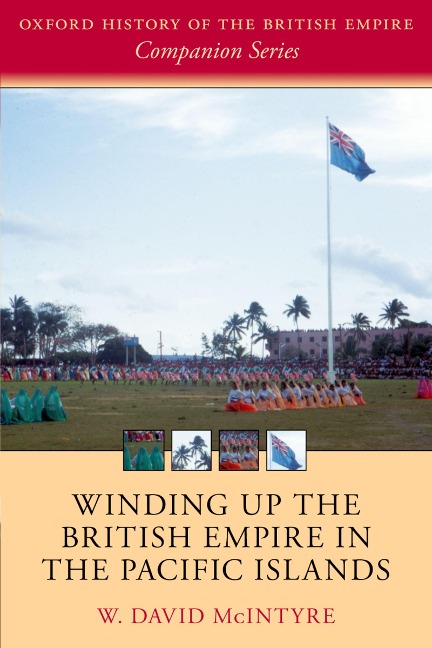
Little has been written about when, how and why the British Government changed its mind about giving independance to the Pacific Islands. Using recently opened archives, Winding Up the British Empire in the Pacific Islands gives the first detailed account of this event. As Britain began to dissolve the Empire in Asia in the aftermath of the Second World War, it announced that there were some countries that were so small, remote, and lacking in resources that they could never become independent states. However, between 1970 and 1980 there was a rapid about-turn. Accelerated decolonization suddenly became the order of the day. Here was the death warrant of the Empire, and hastily-arranged independence ceremonies were performed for six new states - Tonga, Fiji, Solomon Islands, Tuvalu, Kiribati, and Vanuatu. The rise of anti-imperialist pressures in the United Nations had a major role in this change in policy, as did the pioneering examples marked by the release of Western Samoa by New Zealand in 1962 and Nauru by Australia in 1968. The tenacity of Pacific Islanders in maintaining their cultures was in contrast to more strident Afro-Asia nationalisms. The closing of the Colonial Office, by merger with the Commonwealth Relations Office in 1966, followed by the joining of the Commonwealth and Foreign Offices in 1968, became a major turning point in Britain's relations with the Islands. In place of long-nurtured traditions of trusteeship for indigenous populations that had evolved in the Colonial Office, the new Foreign & Commonwealth Office concentrated on fostering British interests, which came to mean reducing distant commitments and focussing on the Atlantic world and Europe.
W. David McIntyre was educated at Peterhouse, Cambridge, the University of Washington, Seattle, and the School of Oriental and African Studies, University of London. After teaching for the Universities of Maryland, British Columbia, and Nottingham, he became Professor of History at the University of Canterbury New Zealand between 1966 and 1997. As Honorary Special Correspondent of The New Zealand International Review he reported on Commonwealth Heads of Government Meetings from 1987 to 2011.
- Preface - Prologue - PART I: Oceania Overview - 1: 'Imperialism, as such, is a newly coined word': Empire and Oceania - 2: 'The task of "Empire-Unbuilding" is a Difficult One': Decolonization - 3: 'Britain's Withdrawal East of Suez is also a Withdrawal West of Panama'. The End in the Pacific: When, Why, and How? - PART II: Holding On - 4: 'A Dramatic and Liberal Gesture': Attlee's Secret Smaller Territories Enquiry, 1949-51 - 5: 'Limbo', 'Mezzanine Status', and 'Independence Minus': Self-Government within the Commonwealth - 6: 'Something of a Profit and Loss Account': Macmillan's Audit of Empire and Aftermath, 1957-60 - PART III: Letting Go - 7: 'The Cold War Front is Advancing Upon Oceania': Pressures from the United Nations, 1960-61 - 8: 'To Complete the Process of Decolonization as soon as Possible': Whitehall's Response to the UN Declaration, 1962-64 - 9: 'Coming to the Most Difficult Period of Decolonization': The Lady Margaret Hall Conference, 1965 - 10: 'A Line Would have to be Drawn Somewhere': Oceania and the Paradox of the Expanding United Nations, 1965-68 - PART IV: Winding Up - 11: 'The British Empire is Past History'. Retreat from 'Never' Land Begins: Tonga and Fiji, 1970 - 12: 'Independence and Self-Government have the Same Value': Self-Determination for Niue, 1970-74 - 13: 'It is More Blessed to Go than be Pushed': The 1973 Programme Analysis and Review - 14: 'To Encourage Australia and New Zealand to Take a Larger Share': The Anzac Role in Decolonization - 15: 'Liquidating Colonial Arrangements with as much Speed as could be Decently Mustered'. Accelerated Decolonization: Solomon Islands - 16: 'We Cannot Now Apply the Brakes'. Accelerated Decolonization: Gilbert and Ellice Islands, 1975-78 - 17: 'The Most Difficult Pre-Independence Conference We have had for a Pacific Territory'. Accelerated Decolonization: Kiribati and Banaba, 1968-79 - 18: 'The Dying Art of Decolonization is Difficult to Pursue in a Condominium'. Accelerated Decolonization: New Hebrides - Epilogue - Bibliography
Dieses eBook wird im PDF-Format geliefert und ist mit einem Adobe Kopierschutz (DRM) versehen. Sie können dieses eBook mit allen Geräten lesen, die das PDF-Format und den Adobe Kopierschutz (DRM) unterstützen.
Zum Beispiel mit den folgenden Geräten:
• tolino Reader
Laden Sie das eBook direkt über den Reader-Shop auf dem tolino herunter oder übertragen Sie das eBook auf Ihren tolino mit einer kostenlosen Software wie beispielsweise Adobe Digital Editions.
• Sony Reader & andere eBook Reader
Laden Sie das eBook direkt über den Reader-Shop herunter oder übertragen Sie das eBook mit der kostenlosen Software Sony READER FOR PC/Mac oder Adobe Digital Editions auf ein Standard-Lesegeräte mit epub- und Adobe DRM-Unterstützung.
• Tablets & Smartphones
Möchten Sie dieses eBook auf Ihrem Smartphone oder Tablet lesen, finden Sie hier unsere kostenlose Lese-App für iPhone/iPad und Android Smartphone/Tablets.
• PC & Mac
Lesen Sie das eBook direkt nach dem Herunterladen mit einer kostenlosen Lesesoftware, beispielsweise Adobe Digital Editions, Sony READER FOR PC/Mac oder direkt über Ihre eBook-Bibliothek in Ihrem Konto unter „Meine eBooks“ - „online lesen“.
Schalten Sie das eBook mit Ihrer persönlichen Adobe ID auf bis zu sechs Geräten gleichzeitig frei.
Bitte beachten Sie, dass die Kindle-Geräte das Format nicht unterstützen und dieses eBook somit nicht auf Kindle-Geräten lesbar ist.