Und dann auf "Zum Home-Bildschirm [+]".

Stöbern
genialokal zum Startbildschirm hinzufügen
Installieren Sie die genialokal App auf Ihrem Startbildschirm für einen schnellen Zugriff und eine komfortable Nutzung.
Installieren Sie die genialokal App auf Ihrem Startbildschirm für einen schnellen Zugriff und eine komfortable Nutzung.
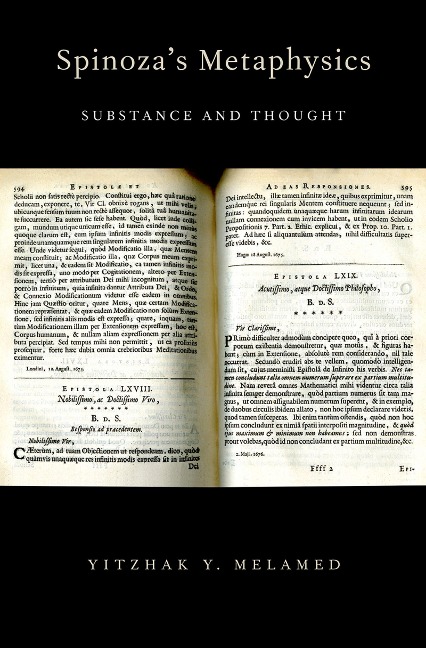
Yitzhak Melamed here offers a new and systematic interpretation of the core of Spinoza's metaphysics. In the first part of the book, he proposes a new reading of the metaphysics of substance in Spinoza: he argues that for Spinoza modes both inhere in and are predicated of God. Using extensive textual evidence, he shows that Spinoza considered modes to be God's propria. He goes on to clarify Spinoza's understanding of infinity, mereological relations, infinite modes, and the flow of finite things from God's essence. In the second part of the book, Melamed relies on this interpretation of the substance-mode relation and the nature of infinite modes and puts forward two interrelated theses about the structure of the attribute of Thought and its overarching role in Spinoza's metaphysics. First, he shows that Spinoza had not one, but two independent doctrines of parallelism. Then, in his final main thesis, Melamed argues that, for Spinoza, ideas have a multifaceted (in fact, infinitely faceted) structure that allows one and the same idea to represent the infinitely many modes which are parallel to it in the infinitely many attributes. Thought turns out to be coextensive with the whole of nature. Spinoza cannot embrace an idealist reduction of Extension to Thought because of his commitment to the conceptual separation of the attributes. Yet, within Spinoza's metaphysics, Thought clearly has primacy over the other attributes insofar as it is the only attribute which is as elaborate, as complex, and, in some senses, as powerful as God.
Yitzhak Y. Melamed is a Professor in the Philosophy Department at Johns Hopkins University. He works on Early Modern Philosophy, German Idealism, and some issues in contemporary metaphysics (time, mereology, and trope theory). Recently he won the ACLS Burkhardt (2011), NEH (2010), and Humboldt (2011) fellowships for his next major book project: Spinoza and German Idealism: A Metaphysical Dialogue.
Contents
Introduction Chapter 1: The Substance-Mode Relation as a Relation of Inherence and Predication Chapter 2: Immanent Cause, Acosmism, and the Distinction between 'Modes of God' and 'Modes of an Attribute' Chapter 3: Inherence, Causation, and Conception Chapter 4: The Infinite Modes Chapter 5: Spinoza's Two Doctrines of Parallelism Chapter 6: The Multifaceted Structure of Ideas and the Priority of Thought Bibliography Index
Dieses eBook wird im PDF-Format geliefert und ist mit einem Adobe Kopierschutz (DRM) versehen. Sie können dieses eBook mit allen Geräten lesen, die das PDF-Format und den Adobe Kopierschutz (DRM) unterstützen.
Zum Beispiel mit den folgenden Geräten:
• tolino Reader
Laden Sie das eBook direkt über den Reader-Shop auf dem tolino herunter oder übertragen Sie das eBook auf Ihren tolino mit einer kostenlosen Software wie beispielsweise Adobe Digital Editions.
• Sony Reader & andere eBook Reader
Laden Sie das eBook direkt über den Reader-Shop herunter oder übertragen Sie das eBook mit der kostenlosen Software Sony READER FOR PC/Mac oder Adobe Digital Editions auf ein Standard-Lesegeräte mit epub- und Adobe DRM-Unterstützung.
• Tablets & Smartphones
Möchten Sie dieses eBook auf Ihrem Smartphone oder Tablet lesen, finden Sie hier unsere kostenlose Lese-App für iPhone/iPad und Android Smartphone/Tablets.
• PC & Mac
Lesen Sie das eBook direkt nach dem Herunterladen mit einer kostenlosen Lesesoftware, beispielsweise Adobe Digital Editions, Sony READER FOR PC/Mac oder direkt über Ihre eBook-Bibliothek in Ihrem Konto unter „Meine eBooks“ - „online lesen“.
Schalten Sie das eBook mit Ihrer persönlichen Adobe ID auf bis zu sechs Geräten gleichzeitig frei.
Bitte beachten Sie, dass die Kindle-Geräte das Format nicht unterstützen und dieses eBook somit nicht auf Kindle-Geräten lesbar ist.