Und dann auf "Zum Home-Bildschirm [+]".

Stöbern
genialokal zum Startbildschirm hinzufügen
Installieren Sie die genialokal App auf Ihrem Startbildschirm für einen schnellen Zugriff und eine komfortable Nutzung.
Installieren Sie die genialokal App auf Ihrem Startbildschirm für einen schnellen Zugriff und eine komfortable Nutzung.
Ihr gewünschter Artikel ist in 0 Buchhandlungen vorrätig - wählen Sie hier eine Buchhandlung in Ihrer Nähe aus:


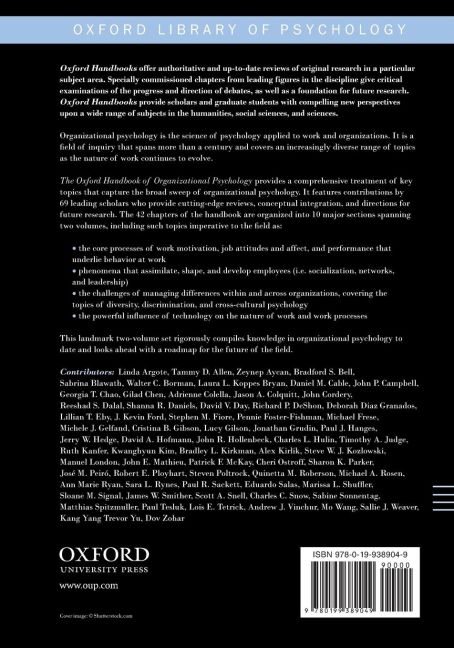
Organizational psychology is the science of psychology applied to work and organizations. It is a field of inquiry that spans more than a century and covers an increasingly diverse range of topics as the nature of work continues to evolve.
The Oxford Handbook of Organizational Psychology provides a comprehensive treatment of key topics that capture the broad sweep of organizational psychology. It features contributions by 69 leading scholars who provide cutting-edge reviews, conceptual integration, and directions for future research. The 42 chapters of the handbook are organized into 10 major sections spanning two volumes, including such topics imperative to the field as:
- the core processes of work motivation, job attitudes and affect, and performance that underlie behavior at work
- phenomena that assimilate, shape, and develop employees (i.e. socialization, networks, and leadership)
- the challenges of managing differences within and across organizations, covering the topics of diversity, discrimination, and cross-cultural psychology
- the powerful influence of technology on the nature of work and work processes
This landmark two-volume set rigorously compiles knowledge in organizational psychology to date and looks ahead with a roadmap for the future of the field.
Steve W. J. Kozlowski is Professor of Organizational Psychology at Michigan State University. He serves as the editor for the Journal of Applied Psychology.
- VOLUME 1
- Part One: An Introduction to Industrial and Organizational Psychology
- 1. The Nature of Industrial and Organizational Psychology
- Steve W. J. Kozlowski
- 2. A History of Industrial and Organizational Psychology
- Laura L. Koppes Bryan and Andrew J. Vinchur
- Part Two: The Foundation
- 3. Seeking the Holy Grail in Organizational Psychology:
- Establishing Causality through Research Design
- Paul J. Hanges and Mo Wang
- 4. Multivariate Dynamics in Organizational Science
- Richard P. DeShon
- 5. Individual Differences: Challenging our Assumptions
- Ann Marie Ryan and Paul R. Sackett
- 6. Behavior, Performance, and Effectiveness: In the 21st Century
- John P. Campbell
- Part Three: Aligning Person and Job Characteristics
- 7. Recruitment and Competitive Advantage: A Brand Equity Perspective
- Kang Yang Trevor Yu and Daniel M. Cable
- 8. Personnel Selection:
- Ensuring Sustainable Organizational Effectiveness Through the Acquisition of Human Capital
- Robert E. Ployhart
- 9. Work Design: Creating Jobs and Roles that Promote Individual Effectiveness
- John Cordery and Sharon K. Parker
- 10. Performance Management
- James W. Smither
- 11. Learning, Training, and Development in Organizations
- Eduardo Salas, Sallie J. Weaver, and Marissa L. Shuffler
- 12. Person-Environment Fit in Organizational Settings
- Cheri Ostroff
- 13. The Research-Practice Gap in I/O Psychology and Related Fields:
- Challenges and Potential Solutions
- Sara L. Rynes
- Part Four: Motivation, Job Attitudes and Affect, and Performance
- 14. Work Motivation: Theory, Practice, and Future Directions
- Ruth Kanfer
- 15. Job Satisfaction and Job Affect
- Timothy A. Judge, Charles L. Hulin, and Reeshad S. Dalal
- 16. Organizational Justice
- Jason A. Colquitt
- 17. Dynamic Performance
- Sabine Sonnentag and Michael Frese
- Part Five: Informal Learning, Meaning Creation, and Social Influence
- 18. Organizational Socialization:
- Background, Basics, and a Blueprint for Adjustment at Work
- Georgia T. Chao
- 19. Workplace Mentoring: Past, Present and Future Perspectives
- Lillian T. Eby
- 20. Organizational Culture and Climate
- Dov M. Zohar and David A. Hofmann
- 21. A Social Network Perspective on Industrial/Organizational Psychology
- Daniel J. Brass
- 22. Leadership
- David V. Day
- VOLUME 2
- Part Six: Work Teams in Organizations
- 23. Team Structure: Tight versus Loose Coupling in Task-Oriented Groups
- John R. Hollenbeck and Matthias Spitzmuller
- 24. Team Participation and Empowerment - Gilad Chen and Paul Tesluk
- Gilad Chen and Paul Tesluk
- 25. Across Borders and Technologies: Advancements in Virtual Teams Research
- Bradley L. Kirkman, Christina B. Gibson, and Kwanghyun Kim
- 26. Team Learning: A Theoretical Integration and Review
- Bradford S. Bell, Steve W. J. Kozlowski, and Sabrina Blawath
- 27. Criteria Issues and Team Effectiveness
- John E. Mathieu and Lucy Gilson
- Part Seven: Organizational Learning, Development, and Adaptation
- 28. Organizational Learning and Knowledge Management
- Linda M. Argote
- 29. Organizational Development and Change:
- Linking Research from the Profit, Nonprofit and Public Sectors
- J. Kevin Ford and Pennie Foster-Fishman
- 30. Strategic Human Resource Management
- Charles Snow and Scott A. Snell
- Part Eight: Managing Differences Within and Across Organizations
- 31. Managing Diversity
- Quinetta M. Roberson
- 32. Employment Discrimination
- Adrienne J. Colella, Patrick F. McKay, Shanna R. Daniels, and Sloane M. Signal
- 33. Cross-Cultural Organizational Psychology
- Zeynep Aycan and Michele J. Gelfand
- Part Nine: The Interface of Work and Life
- 34. The Work and Family Interface
- Tammy D. Allen
- 35. Lifelong Learning
- Manuel London
- 36. Occupational Safety and Health
- Lois Tetrick and José M. Peiró
- 37. Work and Aging
- Jerry W. Hedge and Walter C. Borman
- Part Ten: Technology, System Design, and Human Performance
- 38. An Overview of Human Factors Psychology
- Alex Kirlik
- 39. Cognition and Technology: Interdisciplinarity and the Impact of Cognitive Engineering
- Research on Organizational Productivity
- Stephen M. Fiore
- 40. Taxonomy and Theory in Computer Supported Cooperative Work
- Jonathan Grudin and Steven E. Poltrock
- 41. Decision Making in Naturalistic Environments
- Eduardo Salas, Michael A. Rosen, and Deborah DiazGranados
- Postscript
- 42. On the Horizon
- Steve W.J. Kozlowski