Und dann auf "Zum Home-Bildschirm [+]".

Stöbern
genialokal zum Startbildschirm hinzufügen
Installieren Sie die genialokal App auf Ihrem Startbildschirm für einen schnellen Zugriff und eine komfortable Nutzung.
Installieren Sie die genialokal App auf Ihrem Startbildschirm für einen schnellen Zugriff und eine komfortable Nutzung.
Ihr gewünschter Artikel ist in 0 Buchhandlungen vorrätig - wählen Sie hier eine Buchhandlung in Ihrer Nähe aus:

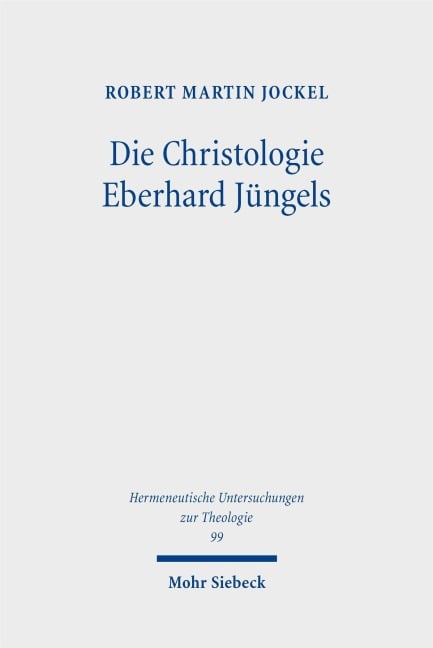
Robert Martin Jockel undertakes a systematic (re)construction of Eberhard Jüngel's Christology on the basis of the guiding idea of the humanity of God as a story to be told, thus rendering it plausible as a narrative-hermeneutical Christology. The narrative that Christology reflects upon is divided, following the model of Barth's doctrine of reconciliation (CD IV) so fundamental for Jüngel, into two relational movements and their unity, so that the story of Jesus Christ becomes evident as the story of God as well as of the man corresponding to God, and so that Christology emerges as a hermeneutics of the narratively mediated unity of both. In various moves, the author thus always begins with Jüngel's central christological category: the self-identification of God with the crucified Jesus. He first presents it as a "post-metaphysical" equivalent to the doctrine of the two natures and as a foundational ground of trinitarian theology, traces its occurrence in the cross and the resurrection, and sketches its implications for the doctrine of justification as well as for the human Jesus himself. Jesus' story is read as one qualified by God's act of identification with him in such a way that Jesus becomes the mediating link in a structure of analogy between God and humankind that extends to the christological grounding of anthropology. The specific relationality of this man's being - historically accessible by approximation through his insistence on the Basileia of God - becomes a paradigmatic case of holistic human existence and thus of existential ontology. Subsequently, from identification as linguistic event, the christological grounding of Jüngel's language hermeneutics and pneumatology becomes evident. Language event, metaphor, analogy, and narrative itself prove to be christologically grounded and, in a pneumatological-narrative manner, effect the present being of Jesus Christ even today, making clear that in Christology, language and being, hermeneutics and material dogmatics, correspond to one another. Problems that surface in this christological logic, which threatens to overburden language, are addressed by consistently carrying Jüngel's approach forward in narrative-theoretical terms and interpreting it constructively and critically: Jesus Christ not 'merely' as a language event, but as a narrative event.
Born 1993; 2025 Dr. theol. at Goethe University Frankfurt am Main; research associate at the Chair of Systematic Theology/Ethics, Institute of Protestant Theology, Justus Liebig University Giessen.
Einleitung
1. Zum Anliegen dieser Untersuchung
2. Die Stellung der Christologie in Jüngels "irregular dogmatics": Quellenlage und Methodik
3. Zur Sekundärliteratur
4. Zu Jüngels 'barthianischer' Denkform
5. Christologie als (Nachvollzug einer) große(n) Erzählung: Zum Aufbau dieser Untersuchung
I. Jesus Christus als Geschichte Gottes
1. Die Selbstidentifikation Gottes mit dem Gekreuzigten: Jesus Christus als sacramentum
2. Jüngels christologisch begründete Trinitätslehre
3. Das Kreuzesgeschehen
4. Die Auferweckung des Gekreuzigten
5. Jüngels Rechtfertigungslehre als 'Anwendung' der Christologie
6. Analeptische Ontologie: Das Sein des Menschen Jesus von Ostern her
II. Das Sein Jesu Christi als Geschichte des Gott entsprechenden Menschen
1. Die Selbstidentifikation Gottes mit der Geschichte eines konkreten Menschen: Die dogmatische Bedeutung des historischen Jesus
2. Jesus als Gleichnis Gottes und wahrer Mensch
3. Die anhypostatische Existenz des Menschen Jesus
4. Analogische Anthropologie: Christologie als Existenzialontologie
III. Christologie als Hermeneutik der Menschlichkeit Gottes als Geschichte
1. Jüngels Christologie als Hermeneutik einer narrativen Theologie
2. Jüngels hermeneutische Geistchristologie
3. Die Menschlichkeit Gottes als Geschichte in Jüngels Predigten
4. Die Möglichkeit als intentionalistische Metametapher: Zur Kritik an Jüngels ontologischer Logik
IV. Systematische Weiterführung: Ein erzähltheoretischer Kritik- und Deutungsversuch
1. Die Erzählung als Hintergrundmetapher der Christologie
2. Erzähltheoretische Fortschreibungen von Jüngels Christologie
3. Systematische Pointierung: Jesus Christus als Erzählereignis
Zusammenfassung